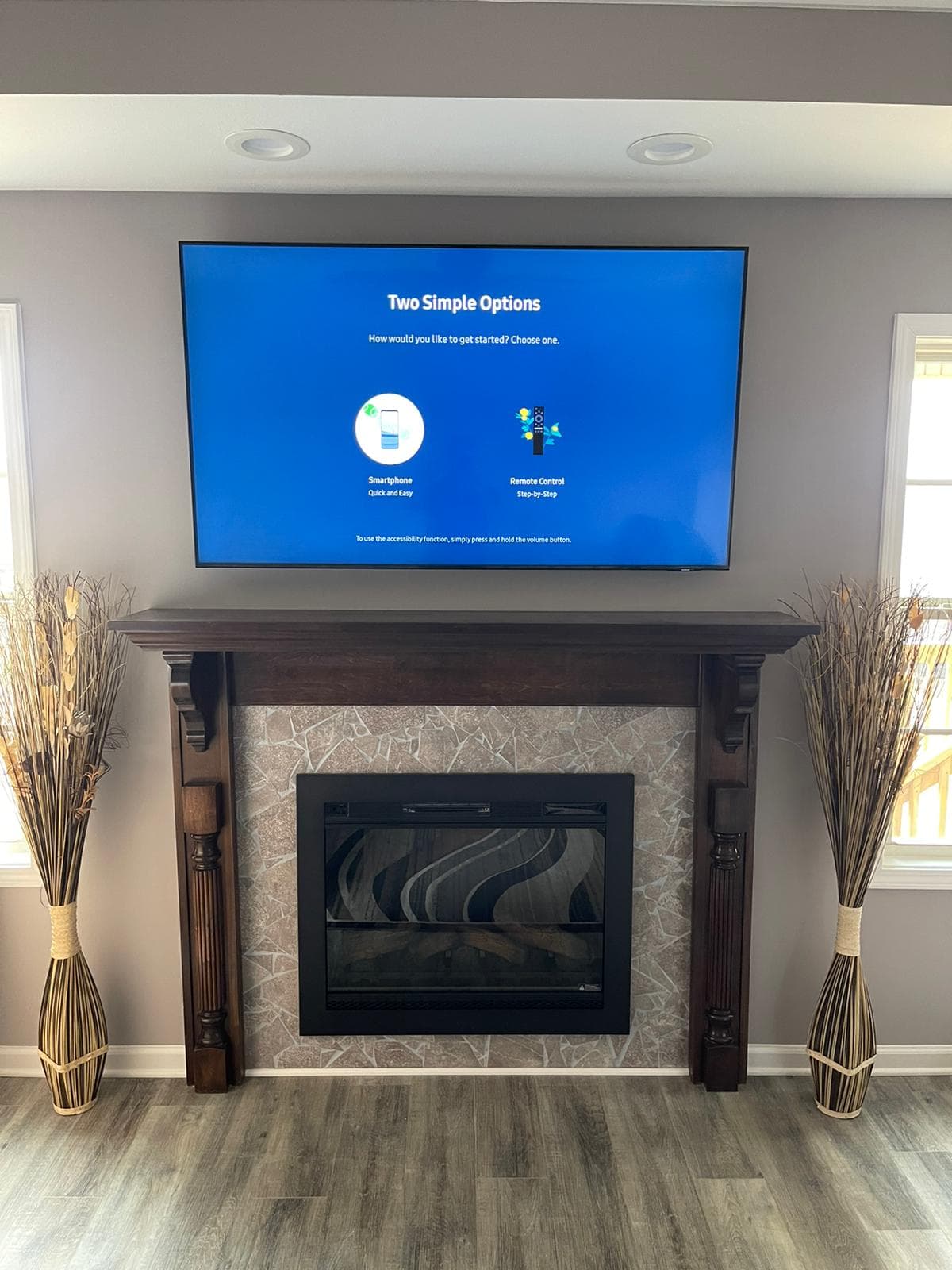
The LG QNED 75B sits in an interesting spot. It is not a budget LED set and it is not an OLED, and that middle position decides how it gets installed.
Because it is backlit, it is stiff. It tolerates handling that would damage an OLED, and none of the on-edge, never-face-down discipline we apply to a C-series panel is necessary here. Because it is 75 inches, it is heavy and wide, so everything that makes a large-format install a two-person job applies in full.
In other words: handle it like an LED, mount it like a big one.
Why That Distinction Matters
We spend a lot of words elsewhere on this site warning people about OLED panels — that they flex, that they cannot be laid flat, that one person holding one is a bad idea for reasons that have nothing to do with weight.
None of that is true of the QNED 75B. There is a backlight assembly behind the screen, and that assembly makes the whole panel rigid. You can rest it on its edge on a carpet, you can lean it against a wall while you get the drill, and it will be fine.
What you cannot do is treat 75 inches as a one-person size. That part is about reach and weight, not technology, and it does not change.
If you are cross-shopping and you end up with an LG OLED instead, the handling rules are genuinely different. Worth knowing before the box is open.
Step 1: Work Out What the Wall Is
A 75-inch panel typically runs in the 60 to 85 lb range. Where that load goes depends on the construction.
Timber framing on 16-inch centres is the standard case in Nashville. Older homes can have plaster over lath. Condo conversions often use metal stud partitions. Chimney breasts are masonry. All four will hold a QNED 75B; all four want different hardware.
Surcharge for concrete, tile, stone or metal starts at $25. Drywall carries no extra charge.
Step 2: Find Two Studs and Confirm Them
Mark every stud finder hit, then verify each one before you trust it — a pass from the opposite direction, or a magnet picking up the vertical line of drywall screws.
Centre the bracket across two studs. On 16-inch framing a 75-inch mount will often reach three, and a third is free insurance.
Drywall anchors are not an option at this weight, whatever the packet says.
Step 3: Pick the Bracket for the Room
The QNED 75B is a conventional backlit panel, which means it is not especially deep and all three bracket types are reasonable:
- Fixed — closest to the wall, no adjustment afterwards
- Tilt — a few degrees of downward angle, useful if the set has to sit high
- Full-motion — swings out and rotates, good for open-plan rooms, adds depth and leverage
At 75 inches a full-motion arm is workable but it is a real trade-off. The arm adds depth, adds leverage on the anchors, and wants solid timber behind it. If all you want is the screen flat against the wall, a slim fixed mount is the better answer and the cheaper one.
We do not sell mounts. Tell us the model and the wall type and we will tell you which class to order.
Step 4: Height, From the Sofa
Centre of the screen at seated eye level, roughly 42 to 48 inches off the floor.
At 75 inches, verify that in the actual room. The screen is tall enough that a textbook centre height can put the bottom edge down where a soundbar or console interferes. Furniture in place, someone sitting on it, mark the wall from there and look at it before you drill.
Step 5: Two People for the Lift
A 75-inch QNED is wider than one person can span. The dangerous moment is at head height, holding the full weight with both arms, feeling blindly for the bracket hooks.
One person carries, one guides and confirms the seat. We send two technicians on every 75-inch install.
Step 6: Old TV First, If There Is One
The QNED 75B is very often an upgrade rather than a first TV, so there is usually something already on the wall.
Tell us at booking so we allow the time, and expect us to look at what is in the wall rather than reuse it on faith. Old brackets anchored into drywall alone, or into one stud with anchors either side, turn up more often than you would like. Reusing that just transfers the problem to a heavier panel. We re-anchor properly instead.
Step 7: Cables and a Real Test
If you want cables inside the wall, plan it before the bracket is fixed — entry and exit points depend on where the TV lands. Concealment starts from $60 per TV, with a paintable surface raceway as the fallback.
Then test it: power on, cycle every input, confirm the soundbar and console actually pass through the set.
What It Costs
Mounting starts from $140 per TV for anything over 55 inches, which covers the QNED 75B. Two sets over 55 inches at the same address in one visit start from $260.
Starting prices. The difficulty, the wall type and the mount decide the final figure; mantel mounts are priced separately; a sales representative confirms your exact price before work begins; prices do not include the bracket.
Book Us
We mount LG across Nashville, Brentwood, Gallatin, Lebanon, Mount Juliet and the rest of Middle Tennessee, with a 30-day workmanship warranty behind the job.
- LG TV mounting in Nashville — OLED, QNED and LED
- 75-inch TV mounting — what changes at this size across every brand
- Book an installation or call (615) 669-0251
PrimeTvNashville is an independent TV mounting and installation company. We are not affiliated with, authorized by or endorsed by LG. Brand and model names are used only to describe the equipment we install.